


How a hardscape gets built, and why the base decides everything
Almost everything that goes wrong with a patio or a wall was decided before the first stone was set. This is the sequence, from excavation to the last joint.
Landscape spikes are the cheapest part of any edge: a few dollars of steel holding the line between a patio and the lawn, or a planting bed and the grass. They are also the part that gets blamed when the edge goes wrong. Walk any Wichita neighborhood in March and you will see it — paver edging standing proud of the ground, spikes half out of their holes, a bed border leaning into the lawn after its first winter.
Sometimes the spike really was the wrong one. More often, in our clay, the spike was fine and the ground around it moved. This guide covers both: which spikes and stakes to buy for paver edging, bed borders, landscape fabric and timbers; what length, material and spacing hold up through a Kansas freeze-thaw season that is starting about now; and how to tell, when an edge heaves, whether the problem is the spike or the base under the patio or walk it is meant to hold.
“Landscape spike” covers several different pieces of hardware sold in the same aisle. They are not interchangeable, and most of the failures we see start with the right edging held down by the wrong spike.
This is the short list, for a typical Wichita yard on clay. The numbers are common sizes and starting points; where an edging maker prints its own spacing or stake length, follow theirs.
| Job | What to buy | Length | Spacing |
|---|---|---|---|
| Plastic paver edging on a compacted base | Galvanized steel spikes, ringed or spiral shank if you can get them | 10 in.; 12 in. on soft ground, thin base or tight curves | About every foot; every hole on curves and at joints |
| Aluminum or steel bed edging | The stakes made for that edging profile | Usually a foot or a little more | Every few feet, plus every joint and both ends |
| Plastic coil or no-dig bed edging | Steel spikes in clay; the kit’s plastic anchors only in soft, moist soil | 8–10 in. | About every three feet, closer on curves |
| Landscape fabric under rock | Heavy-gauge U-shaped staples | 6 in. | Every few feet along edges and seams, a few across the middle |
| Landscape timber or tie borders | Galvanized timber spikes between courses; rebar into the ground | 12 in. timber spikes; 18–24 in. rebar | Near each end of every timber and every few feet between |
Ten inches is the standard length, and on a properly built patio it is enough, because the spike is going into compacted aggregate that does not want to let go. Twelve-inch spikes earn their extra cost where the base is thinner than it should be, where the ground beyond the patio is soft or often wet, and on curves, where the edging has fewer straight runs to brace itself. A spike shorter than eight inches has no business holding a paver edge in clay.
Aluminum and steel edging come with stakes designed for their profile, and those are the ones to use. Generic spikes driven beside the edging do not lock into it and let it lean. On our own beds we use black aluminum edging; it holds a crisp curve, does not rust and takes its stakes cleanly.
The plastic anchors in a coil edging kit work in loose garden soil. In Wichita clay they tend to snap or curl on the way in, especially once the ground dries out in late summer. A box of eight- or ten-inch steel spikes costs little and solves it.
Six-inch staples hold fabric in clay well; the thin four-inch kind pull out as soon as anyone walks on the bed. Overlap seams by several inches and pin through both layers, and pin every edge before the rock goes on, because wind gets under unpinned fabric while you are still spreading.
Pin the first course to the ground with lengths of rebar driven through drilled holes, and pin each course above it to the one below with galvanized timber spikes. Drill the holes slightly smaller than the spike so it bites, and keep spikes a few inches back from the ends of each timber so the wood does not split.
A smooth spike holds by friction alone, and friction is exactly what a freeze-thaw winter works against. Ringed, barbed or spiral shanks hold the soil around them mechanically, so they resist being lifted out much better. If the store carries both, the ringed or spiral spike is the one to buy for paver edging. A flat head, or a head with a washer, also matters: it is what actually clamps the edging flange to the ground.
Clay is not a bad soil for spikes. Driven into firm, moist clay, a steel spike grips hard — harder than in sandy soil. The trouble is that clay does not stay the way it was on the day the spike went in.
A Wichita winter does not freeze once and stay frozen. It freezes and thaws over and over from late fall to early spring. Each time wet soil freezes, the water in it expands and lifts the ground, and anything gripped by that ground — a spike, an edging strip, the outer row of pavers — rises with it. When the soil thaws, it settles back, but the spike rarely settles all the way. Over a winter it can work itself up a surprising distance. That is frost jacking, and it is why edges look worst in March.
Two things resist it. Longer, ringed or barbed spikes give the soil more to hold on to. And dry ground heaves far less than wet ground, so an edge with water running away from it, not along it, stays put. That second point does more than any spike.
On a patio or walkway, the edge restraint is what keeps the pavers locked together. Without it, they creep outward under foot traffic and the joints open, slowly at first and then all at once. The restraint is the plastic or aluminum edging; the spikes only hold the restraint in place. And where those spikes finish matters more than how long they are.
The compacted aggregate base under a patio should run out past the last row of pavers, so the edging sits directly on that base and the spikes go down through it. The bedding sand is cut back so the edging never sits on sand: spikes driven through loose sand hold nothing, and the sand washes out from under the edge in the first heavy rain. When the base stops at the paver line, the edging ends up spiked into bare clay, and clay that gets wet every time the patio sheds water is the weakest ground on the property. Our guide to how a hardscape gets built, and why the base decides everything walks through that sequence step by step.
On straight runs, a spike roughly every foot is the common spacing. On curves, the edging is cut or flexed and loses stiffness, so use every hole. Always put a spike within a few inches of each end and on both sides of every joint between lengths of edging; joints are where edges open first. If you can push the top of the edging sideways with your boot after it is spiked, it needs more spikes or better backfill.
Spiked edging is the most common restraint, not the only one. A row of pavers set on end in concrete, a poured concrete curb, or the edge of an existing slab or wall can all hold a patio. Each one is heavier and costs more, and each still depends on what is underneath it. A thin wedge of concrete troweled against the outside of the last paver row is a common shortcut; in our freeze-thaw winters it tends to crack and break away within a few seasons.
Bed edging carries far less load than a paver edge, but it lives in the wettest, most worked-over soil in the yard: watered with the plants, mowed against and trimmed beside every week. How it is set matters as much as what holds it.
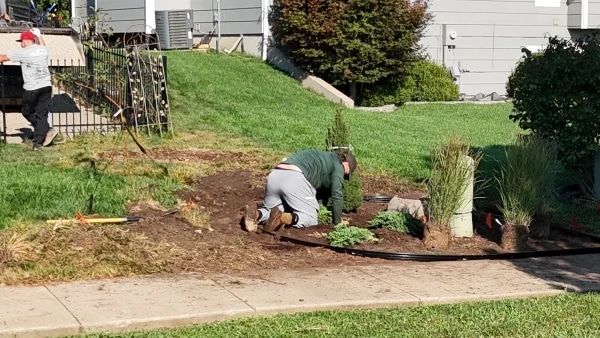
If the bed is going to be rock, fabric and edging work together: the fabric keeps the stone out of the clay and the edging keeps it out of the lawn. Our comparison of river rock and mulch in Wichita beds covers which belongs where, and why the edge does as much as the material.
Every spring, homeowners re-spike edges that will be out again by the next spring, because the spike was never what failed. Before you buy a longer one, read what the edge is telling you.
| What you see | What it usually means |
|---|---|
| Spikes standing up out of the edging; pavers still flat and tight | A spike problem: too short, smooth shank, or driven into wet ground. Re-set with longer, ringed spikes beside the old holes. |
| Edging and outer pavers both rolled outward or dropped | A base problem: the base stops at the paver line, so the edge is sitting on clay or sand. More spikes will not fix it. |
| A dip or trough running along the edge of the patio | The base under the edge was never fully compacted, or water has washed the bedding sand out from under it. |
| A section of patio or walk lifted, often by a downspout or low corner | Water is collecting under the paving and freezing. The fix is drainage first, then rebuilding that section. |
| Joints opening across the middle of the patio, not just at the edge | The edge restraint has let go along a long run, or the base is settling. Usually both, and usually a rebuild. |
| Bed edging leaning or lifting in the same low spot every year | Water sits there. Regrade or move the water, then re-set the edging. |
The pattern is the same in every row but the first: the edge moves because the ground under it does, and the ground moves because of water or because the base was never built out past the edge. Our guide to reading a drainage problem in Wichita clay helps you work out where that water comes from. A patio or walkway that has heaved needs to be taken up and rebuilt from the base, with the base extended and the water sent somewhere else — which is why how we plan custom patios in Wichita starts with the property and the water, not the pavers.
A ten-inch spike sounds too short to hit anything, and it is not. Sprinkler lines, drip irrigation and low-voltage lighting cable are often buried only a few inches down, and they tend to run right along bed edges and patio borders — exactly where the spikes go. If you have a lighting or irrigation system, find out where its lines run before you start, and drive carefully where you are not sure. For rebar stakes and anything near where utilities enter the house, start with a free Kansas 811 locate request; a spike through a shallow gas or electric service line is not a weekend repair.
They hold edging and borders in place: plastic paver edging along a patio or walk, metal or plastic edging around planting beds, landscape fabric under rock, and timber borders. The spike does not hold the edge up on its own — it pins the edging to the ground or base beneath it, and the soil packed on both sides does the rest.
Ten-inch steel spikes are the usual size for plastic paver edging set on a compacted base. Step up to twelve inches where the base is thin, the ground is soft or the edge takes a lot of weight, and on tight curves. Whatever the length, the spike has to finish in compacted aggregate and firm soil, not in loose bedding sand.
For paver edging, roughly one spike every foot on straight runs — the spacing most edging makers print on the box — and one in every hole on curves and at each joint between lengths. Metal bed edging uses fewer, longer stakes, set every few feet and at every joint and end. Fabric staples go every few feet along each edge and seam.
Galvanized steel lasts longest and will not stain pavers or concrete with rust. Plain steel spikes rust in the ground, and that roughened surface actually grips clay well, but the rust can bleed onto light pavers at the surface. Plastic spikes are fine for fabric and light coil edging in soft ground; they tend to snap in dry Wichita clay.
A straight spike can be reused, but not in its old hole — the clay around it is already loosened and will not grip. Drive it an inch or two to one side, or swap in a longer or ring-shank spike. A bent spike goes in the bin; straightening it weakens the steel and it will bend again in hard ground.
Wait for moist ground, or soak the line the evening before; dry August clay bends spikes and wet March clay will not hold them. Use a heavy hammer rather than a claw hammer, keep the spike plumb and stop if it meets something solid. Move an inch over rather than forcing it, because the obstruction might be a stone, a root or a buried line.
They hold best where the ground under them stays drained. Wet clay expands as it freezes and lifts whatever is in it, so a spike in a wet edge gets jacked up a little through the winter. Longer spikes with ringed or barbed shanks resist it, but the lasting fix is keeping water away from the edge — and pushing any lifted spikes back down once the ground thaws.
Fall, before the ground freezes, so the edge goes into winter tight, and again in spring once the ground has thawed and drained. Fall is also our busiest season for design and build work; we are typically booked out 2 to 4 weeks depending on the season.
Landscape spikes are worth getting right, and they are cheap enough to get right the first time. But if the patio or walkway they hold has started to roll, sink or heave, the fix is underneath. Book a consultation and we will look at the edge, the base and where the water goes, and tell you whether it needs a few new spikes or a rebuild. Our landscape design process plans patios, walks and beds together, so edges, drainage and planting are settled before anything is built. We design and build landscapes in Wichita and the surrounding communities of Andover, Derby, Maize and Goddard.
Almost everything that goes wrong with a patio or a wall was decided before the first stone was set. This is the sequence, from excavation to the last joint.
Rock stays put in the wind and never needs topping up; mulch keeps clay cool and feeds it. How the two compare in a Wichita yard — heat, weeds, water at the foundation and years of upkeep — and where each one belongs.
