


Reading a drainage problem in Wichita clay
Clay does not absorb water so much as refuse it. Here are the signs that separate a yard with a drainage fault from a yard that was simply rained on, and what fixes each.
The side of the house is the one part of most yards that nobody designed. The builder left a strip of ground between the wall and the fence, ran the air conditioner, the meters and a downspout or two into it, and moved on. Then everybody started using it: the mower goes through it, the trash cans live in it, and it is the only way from the front yard to the back.
So it ends up muddy, bare or full of weeds, and the usual response — more seed, more mulch, a bag of weed killer — works for a few weeks and then the strip goes back to how it was. That is because a side yard that keeps failing is almost always failing for a reason, and in Wichita it is usually one of four: a downspout emptying into it, ground that slopes toward the house, clay packed hard by years of foot traffic, or shade that grass cannot live in. Each has a fix, and the fix is nearly always a grading, drainage or walkway job rather than a gardening one. Good landscape design for the side of a house starts with working out which of the four you have.
Walk the strip from front to back and match what you see to the table. Most side yards have two of these at once — a downspout and a reversed grade are a common pair — so read the whole list before deciding.
| What you see | The usual cause | The fix |
|---|---|---|
| A muddy patch, a washed-out gully or bare soil below one spot on the gutter | A downspout discharging into the side yard | Carry the water out of the strip in a buried pipe or a rock-lined channel |
| Water standing against the foundation after rain; soil or mulch creeping up the siding | Ground that falls toward the house instead of away from it | Regrade, and shape a shallow swale that carries water to the front or back |
| Hard, cracked, bare ground; puddles that sit for a day; low, wiry weeds | Compacted clay along the route everybody walks | Build a path where people walk, and amend the soil where plants grow |
| Thin grass that dies back every summer, moss, bare soil under the eaves | Shade from the house, the fence or the neighbor’s wall | Stop asking for lawn: a path with shade-tolerant planting or rock either side |
Roofs are shaped to send water to the corners, and on a great many houses at least one of those corners sits in the side yard. An inch of rain on a typical house roof is hundreds of gallons of water, and a downspout delivers its share to one spot about the size of a dinner plate. In a narrow strip there is nowhere for it to spread out, so it cuts a channel, carries the mulch away and leaves a muddy fan where the grass used to be. On a tight lot the neighbor’s downspout may be aimed at the same strip.
Signs that this is the cause:
The fix is to get the water out of the side yard, not to protect the spot it lands on. The usual answer is a buried downspout extension: the downspout is taken into solid pipe below grade and run along the strip to somewhere water is welcome — open lawn, a planted bed built to take it, or toward the street — where it surfaces through a pop-up emitter. Where the strip has enough fall, a dry creek bed of river rock can do the same job on the surface and look like part of the planting. Either way, the water has to end up somewhere that is yours to send it; moving the puddle onto the neighbor’s side of the fence fixes nothing.
A splash block or a short plastic extension only moves the problem a few feet. In a side yard a few feet is the whole width of the strip, which is why those almost never work there. Our guide to reading a drainage problem in Wichita clay goes further into how buried downspouts, regrading and subsurface drains compare.
The soil against a foundation is backfill — dug out to build the basement or footings and pushed back afterward. It settles for years, and as it does, ground that was graded to fall away from the house sinks into a shallow trough along the wall. Add a few seasons of mulch or rock heaped up against the siding and a bed edge that acts like a dam, and the side yard ends up holding water against the house rather than shedding it.
The standard most houses are built to asks for the ground to fall at least six inches in the first ten feet away from the foundation. You can check yours with two stakes, a string and a line level: one stake at the wall, one ten feet out, the string level between them, and a tape to measure how far the ground drops below it. If it drops toward the house, or barely drops at all, that is your answer.
A side yard often does not have ten feet to fall across — the fence or the property line is closer than that. When there is not room for the full slope, the same standard calls for a swale or a drain to carry the water away instead, and that is the design most narrow side yards need:
On Wichita clay the surface does most of the work, because clay takes water in slowly. A side yard with a good surface fall drains better than a flat one with a pipe buried under it. And regrading is groundwork: it has to happen before anything is planted or paved, or the path and the bed get built on top of the problem.
Side yards take a beating twice. During construction the strip is the equipment lane — loaders, skid steers and pallets of material all go down it, and spoil from the dig is often spread across it. After that it becomes the route for every trip from the front to the back. Wichita clay packs down under that traffic until water sits on top of it and roots cannot get into it.
The signs are hard, pale ground that cracks open in July; puddles that take a day to soak in; grass that thins along a line where people walk; and low, wiry weeds such as prostrate knotweed and plantain, which tolerate compacted ground far better than lawn grass does. Pulling the weeds does not help much, because the ground favors them.
The fix depends on what the strip is for. If it is the way everybody walks, stop trying to grow anything there and give that line a proper path, which is the next section. Where you do want plants — along the foundation, or against the fence — loosen the whole bed and work compost through it, not only the planting holes; a rich hole dug into untouched clay fills with water and drowns the roots. Do not dig or till clay while it is wet, which smears it and makes the compaction worse. If the strip is staying as lawn, core aeration in fall loosens the surface, but it only lasts if the foot traffic moves to a path.
A side yard between two houses is a narrow canyon. The north side of a house may see almost no direct sun from fall to spring, and even an east or west side may only get a few hours around the middle of the day before the neighbor’s wall or a privacy fence cuts it off. Tall fescue, the grass many Wichita lawns are planted with, copes with some shade but still needs a few hours of direct sun to stay thick. Below that it thins every summer, the bare soil turns to mud whenever it rains, and weeds and moss move into the gaps.
The fix is to stop asking for lawn there. Reseeding a shaded side yard every fall is paying, every year, for a result the light will not support. Give the strip a path down the middle, and on either side of it plant what does grow in shade — hostas, coral bells, sedges and ferns where the ground stays moist — or finish the edges in river rock where nothing will. Watch the opposite case, too: a west-facing side yard between two light-colored walls can be the hottest ground on the lot in August, and wants tough, heat-tolerant planting or rock rather than anything delicate.
Once the water is going somewhere and the ground falls the right way, most side yards are best treated as what they are: a corridor. A defined path, with planting or rock along the edges, is easier to keep tidy than lawn, survives shade and traffic, and gives the mower, the wheelbarrow and the trash cans somewhere to go.
| Surface | Where it works | What to watch |
|---|---|---|
| Stepping stones set in rock | Light foot traffic; strips where water needs to soak in or pass through | Awkward for wheels; stones set loose on clay rock and sink |
| Crushed rock with steel edging | An inexpensive, permeable path for carts and a mower | Without a firm edge the rock migrates into the beds and the lawn |
| Concrete pavers | The most finished look; units can be lifted and reset if the ground moves | Needs a compacted base and edge restraint, and a set fall away from the house |
| Poured concrete | A clean, low-upkeep route, and it can match the drive | Clay movement cracks slabs; it must be poured to drain away from the wall |
Whichever surface you choose, what decides how long it lasts is the base underneath — its depth, its compaction and how its edges are held. Our article on planning patios and walkways in Wichita covers materials for this climate in more detail.
The side yard at the Graber residence shows how that can look finished: a river rock border set with natural boulders runs along the side of the house and curves around the air conditioner, and new sod was laid right up to its edge, so the strip reads as part of the front landscape rather than leftover ground.
A side yard is a sensible first design project: it is small, it has a clear job, and the problems are easy to see once you know what to look for. These are the questions homeowners ask most when they set out to plan one.
Start with the problem, not the plants. For a side yard that means, in order: watch where water goes during a real rain; measure the strip and the fall away from the house; note how many hours of direct sun it gets in summer; list everything that has to stay reachable — the meters, the air conditioner, the spigot, the gate; and decide what the strip is for, whether that is a path, a planting, storage or all three. Only then choose surfaces and plants. A plan made in that order fixes the side yard; a plan that starts with a plant list decorates it.
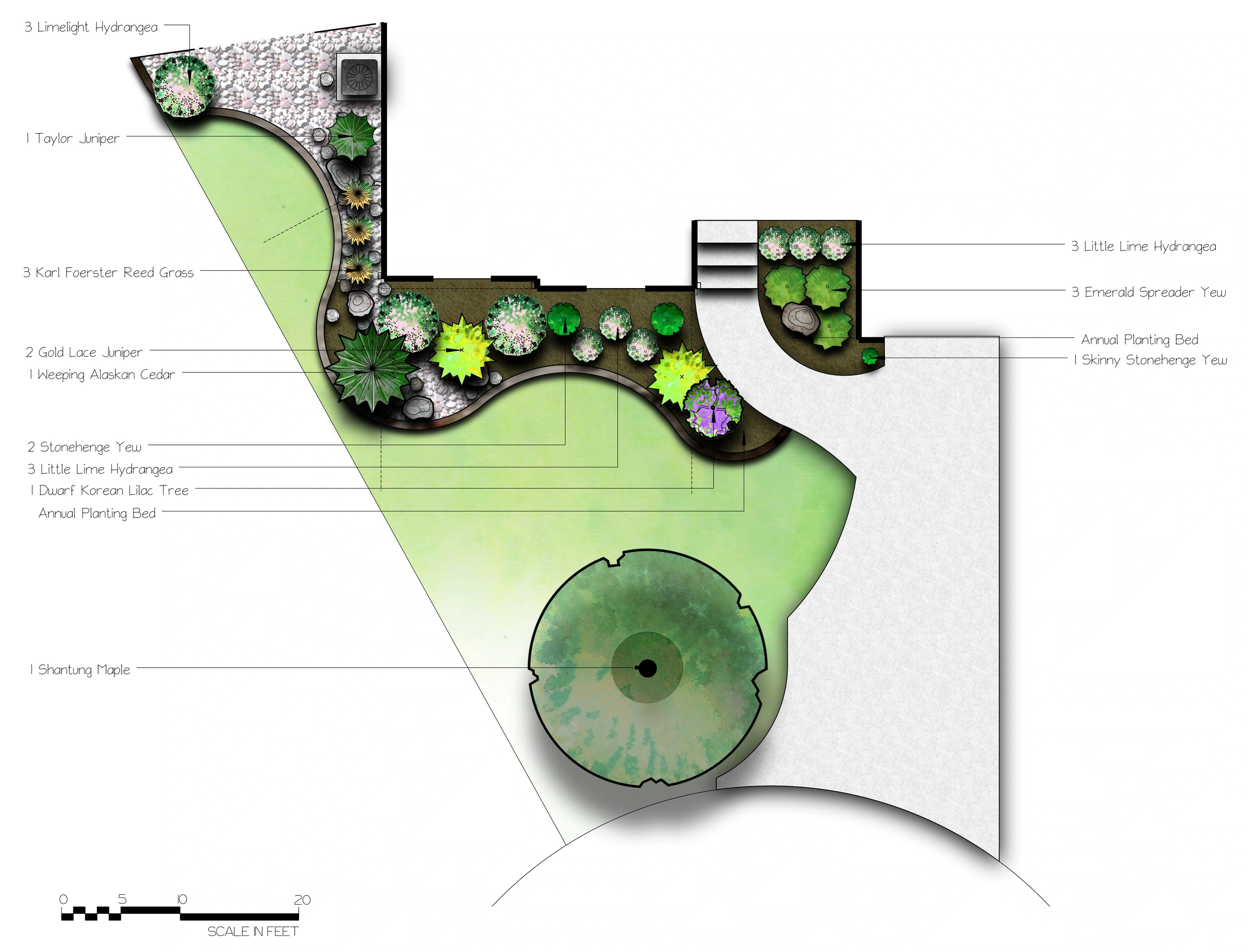
Everything you need is in the garage: a tape measure, graph paper, stakes, string and a line level. Measure the strip at several points, because side yards are rarely parallel, and draw it to scale with one square to the foot. Mark the downspouts, the door and gate, the equipment and the direction water runs. Free satellite imagery is enough to trace the outline of the house and lot, and phone photos from each end help when you are back at the table. A finished plan looks like the one below: the strip, the condenser, the rock and every plant drawn at the size it will grow to.
Yes. There are free garden-planning apps and browser tools, and many paid ones have a free tier that is plenty for one side yard. They are good for trying layouts and seeing roughly how plants fit at their mature size. What none of them can do is read your grade or watch your downspout in a storm, and in a side yard those two things decide more than the layout does.
It can help you think. Ask it which plants tolerate shade, what a swale is or how to set stepping stones, and you will get a useful starting point. It cannot see your yard, though. It does not know that the ground falls toward your foundation, where the downspout empties or how few hours of sun reach the strip — and those are what decide whether a side yard works. Treat its plant suggestions as a list to check against what grows well in south-central Kansas, not as a plan.
Plant in odd-numbered groups — threes most often — rather than pairs or singles. Odd groups read as natural; even ones read as lined up. The rule is also used for layering in three heights: something tall at the back, a middle layer and a low front edge. In a narrow side yard, three of one plant repeated along the wall looks deliberate, where a row of single different plants looks like leftovers from other beds.
Lists differ, but the six principles that come up most are unity (the parts look like they belong together), balance, proportion (things sized to the space and the house), simplicity, rhythm (repetition that leads the eye) and emphasis (one focal point rather than several). On a side yard, simplicity and proportion do most of the work: one path material, one edge, a short plant list repeated, and nothing taller than the strip is wide can carry.
For a side yard that only needs a path and some planting, often not on its own. It is worth it when water is involved, because then the value is in the levels being worked out before anything is built — where the ground falls, where the swale runs and where the downspout lets out. It is also worth it when the side yard is one piece of a bigger project, so the path, the beds and the drainage connect to the front and back rather than being solved three times. Our landscape design process starts with a consultation at your property, and the design presentation follows within about two weeks.
A good deal of this is homeowner work: a downspout extension, a stepping-stone path, replanting a shaded bed. Some of it is not. It is worth having somebody look when water is still standing against the foundation a day after rain; when you cannot find fall to either the front or the back; when a basement wall on that side gets damp; or when the strip needs a retaining wall to hold a change in level between your lot and the neighbor’s.
Those are the jobs where grading, drainage, the path and the planting all have to agree, and they agree most easily when the same team designs and builds them. That is how Earthworks works: the levels are drawn first, and the people who drew them build them.
If your side yard has beaten a few rounds of seed and mulch already, book a design consultation and tell us what it does after a storm. The strip down the side of the house is small, but it is where a lot of a yard’s water goes, which is exactly why it is worth getting right.
Clay does not absorb water so much as refuse it. Here are the signs that separate a yard with a drainage fault from a yard that was simply rained on, and what fixes each.
A compact front yard has no room for an idea that does not earn its place. This is the order to build one in — the walk, then the edge, then the planting — and why fall is the season to start.
