Drought-Tolerant Landscape Design: A Fall Checklist for Wichita Yards
Earthworks ·
Drought-tolerant landscape design gets decided in fall, even though it gets tested in July. The plants that will shrug off next summer’s dry spells need this fall and winter to grow roots. The clay beds they go into can only be loosened and amended while the ground is workable. And the gravel paths and dry creeks that replace thirsty lawn are easiest to build now, on ground that is drier than it will be in April, before the spring rush.
This is a checklist for the stretch from late October to December in Wichita: what to look at, what to plant and what to leave until spring, how to prepare the soil, and which hardscape to put in before the ground freezes. Work through it in order and you will start next summer with a yard built to need less water, rather than one that needs more of it every August.
Why fall is the season for drought-tolerant landscape design
Three things line up in a Wichita fall that do not line up at any other time of year:
Warm soil, cool air. After the first frosts, the soil stays warm for weeks while the air cools. Roots keep growing while the leaves above them ask for very little water, so trees and shrubs planted now go into their first summer already anchored.
Workable ground. Most of Wichita’s rain falls from spring into early summer. Late fall is usually drier, so clay can be dug, amended and compacted without smearing into a slick, airless layer, which is what happens when it is worked wet.
Time before spring. A drought-tolerant yard is as much about layout as plants — where the lawn shrinks, where the water runs, where the gravel goes. Drawing that over the winter means the work is ready to start the moment the ground allows.
The ground here rarely freezes solid for the whole winter; it freezes and thaws in spells, and in most years there are workable days into December. The real deadline is less the freeze than the roots: the later something goes in, the less time it has to settle before the cold, and the more it depends on you to water it through a dry winter.
The fall checklist at a glance
Step
When
What it buys you next summer
1. Map sun, water and dry spots
Late October
Plants chosen for the bed they are in
2. Decide where the lawn shrinks
Late October
Less turf to water through July and August
3. Amend clay beds
Late October to November, on a dry day
Roots that go deep instead of sitting in a wet pocket
4. Plant what roots in fall
Trees and shrubs through November; bulbs in November
Established plants before the first heat
5. Build gravel paths and dry creeks
November into December, before a hard freeze
Hardscape that needs no water and moves storm water
6. Mulch, edge and water in
After the ground cools; water in dry winter spells
Cooler soil, fewer weeds, no winter die-back
7. Get the rest drawn
December to February
A plan ready to build in spring
1. Walk the yard and map the sun, the water and the dry spots
A drought-tolerant yard is not one plant list applied everywhere. It is the right plant in each place, and in Wichita the places vary more than people expect. Before anything is bought, walk the property and note:
The hot beds. South and west walls, beds beside a drive or a patio, and anything in full afternoon sun. These are the places that cook in July and where the toughest plants belong.
Where the lawn browns first. You may remember it from August; if not, the pattern often still shows in fall. Those strips are telling you where turf will always be a struggle.
Where the water goes. Downspouts, the path rain takes across the yard, and the low spots that stay wet after a storm. Clay sheds water fast in a downpour and holds it in the hollows, so a yard can be parched and waterlogged in the same week.
The wind. Open lots in newer subdivisions take the south wind across them all summer, and wind dries plants as fast as sun does.
Then group the yard into zones by how much water each will need. The plants beside the patio, where you want lush and green, can share a zone with drip irrigation. The hot strip along the drive can be planted to live on rainfall once established. Mixing the two in one bed means one group is always over- or under-watered.
2. Decide where the lawn shrinks
Lawn is usually the thirstiest thing in a Wichita yard. Tall fescue, the most common lawn grass here, wants regular water through the summer to stay green, and the strips that fail first every August are rarely the parts of the lawn anyone uses. The single biggest step in drought-tolerant landscape design is deciding which turf earns its water — the play area, the open space the dog runs on — and which can become planting beds, gravel or a path.
Fall is the time to make that decision, but not to seed. The window for seeding tall fescue is early fall and has passed by late October, and native buffalograss is seeded in late spring. What you can do now is mark the new bed lines with a hose or paint, kill or strip the turf inside them, and let the beds sit ready for planting and hardscape. Thin, patchy lawn in a hot strip is often a sign the space wants to be something else.
3. Amend clay beds while the soil can still be worked
Much of Wichita sits on heavy clay that swells when wet, shrinks and cracks when dry, and drains slowly. Drought-tolerant plants are tough about heat and dry spells, but many of them are not tough about wet feet; a prairie plant can come through August and then rot in a clay bed that stays soggy through a wet March. Good soil preparation serves both seasons: it lets roots go deep enough to find water in summer, and lets water drain away from the crowns in winter.
Check the soil is dry enough
Squeeze a handful. If it crumbles, it is ready. If it holds a shiny, sticky ball, wait a few days — digging wet clay smears it into a dense layer that roots and water struggle to get through for years.
Amend the whole bed, not the planting hole
General guidance is to spread two or three inches of compost across the entire bed and work it into the top six to eight inches. Amending only the hole makes a sponge in a clay pot: water collects in the soft pocket and the roots stay in it rather than spreading out. Do not add sand to clay, which tends to make a harder mix, not a looser one. On our Kumar residence renovation, every bed was amended with cotton burr compost and fitted with subsurface drip irrigation before over 89 new plants, shrubs and trees went in.
Raise the beds for plants that hate wet roots
For lavender, Russian sage, yucca and the other plants that rot in winter wet, set the bed a few inches above the surrounding grade, or plant them on a low berm, so water drains away from the crown. If a bed sits wet days after rain no matter what you add, the problem is grading or drainage rather than soil, and our guide to yard drainage in Wichita clay covers how to tell which.
4. Plant what roots in fall, and hold the rest for spring
Not every drought-tolerant plant wants to go in the ground in fall. The woody plants do; many of the heat-loving perennials and grasses do better planted in spring, when warm soil gets their roots moving before their first summer. Getting this split right is what separates a fall planting that thrives from one that heaves out of the ground in February.
Plant group
Good choices for Wichita
Plant it
Shade and structure trees
Bur oak, chinkapin oak, Kentucky coffeetree, Oklahoma redbud, lacebark elm
Fall, through November while the ground can be dug
Shrubs and evergreens
Juniper, fragrant sumac, smokebush
Fall, through November
Spring bulbs
Daffodils, alliums, crocus
November — they are dormant and need no water in summer
Little bluestem, switchgrass, prairie dropseed, blue grama
Spring — they root in warm soil
Heat-lovers that hate winter wet
Russian sage, lavender, yucca, red yucca
Spring, in a raised or gravel bed
Trees and shrubs: the fall priority
A tree planted in fall has months to grow roots before it has to carry a full canopy through July. Water it in deeply, set it at the depth it grew in the nursery with the root flare visible, and keep mulch off the trunk. Space it for its mature size — a bur oak is a generation’s shade, and it needs the room to give it. A shade tree on the west side of the house or the patio is also a drought measure in its own right: the beds and lawn under it lose far less water than those in open sun.
Perennials: early in the window or wait
Container-grown hardy perennials can still go in through late October if you water them in. After that, they have little time to anchor, and the freeze-thaw cycles of a Kansas winter can push a shallow root ball out of the ground. If you buy late, it is usually better to keep the plants in their pots in a sheltered spot, or wait for spring.
Grasses and the true heat-lovers: spring
The native grasses that make the backbone of a drought-tolerant bed — little bluestem, switchgrass, prairie dropseed — are warm-season plants that do their rooting in warm soil. Planted in late fall, they sit still all winter in cold, wet clay. The same goes for Russian sage, lavender and red yucca. Prepare and edge their beds now, then plant in spring when the soil warms.
“Drought-tolerant” means once established
Every plant on that list needs regular water for its first season, and trees for longer. Drip irrigation laid while the beds are open puts water at the roots rather than on the path, and can be turned down as the planting matures. In a dry winter, give new trees and shrubs a deep drink on a mild day when the ground is not frozen, roughly once a month.
5. Build gravel paths and dry creeks before the ground freezes
Hardscape is where a drought-tolerant yard saves the most water, because every path, gravel bed and dry creek is ground that never needs watering. Fall is a good time to build it: the ground is usually drier than in spring, and dry-laid work — gravel, stone set in gravel, cobble and boulders — does not need warm weather to cure the way poured concrete does. It can go in on any day the ground is not frozen or saturated. Build it before you plant around it, so the crews and the wheelbarrows are not crossing finished beds.
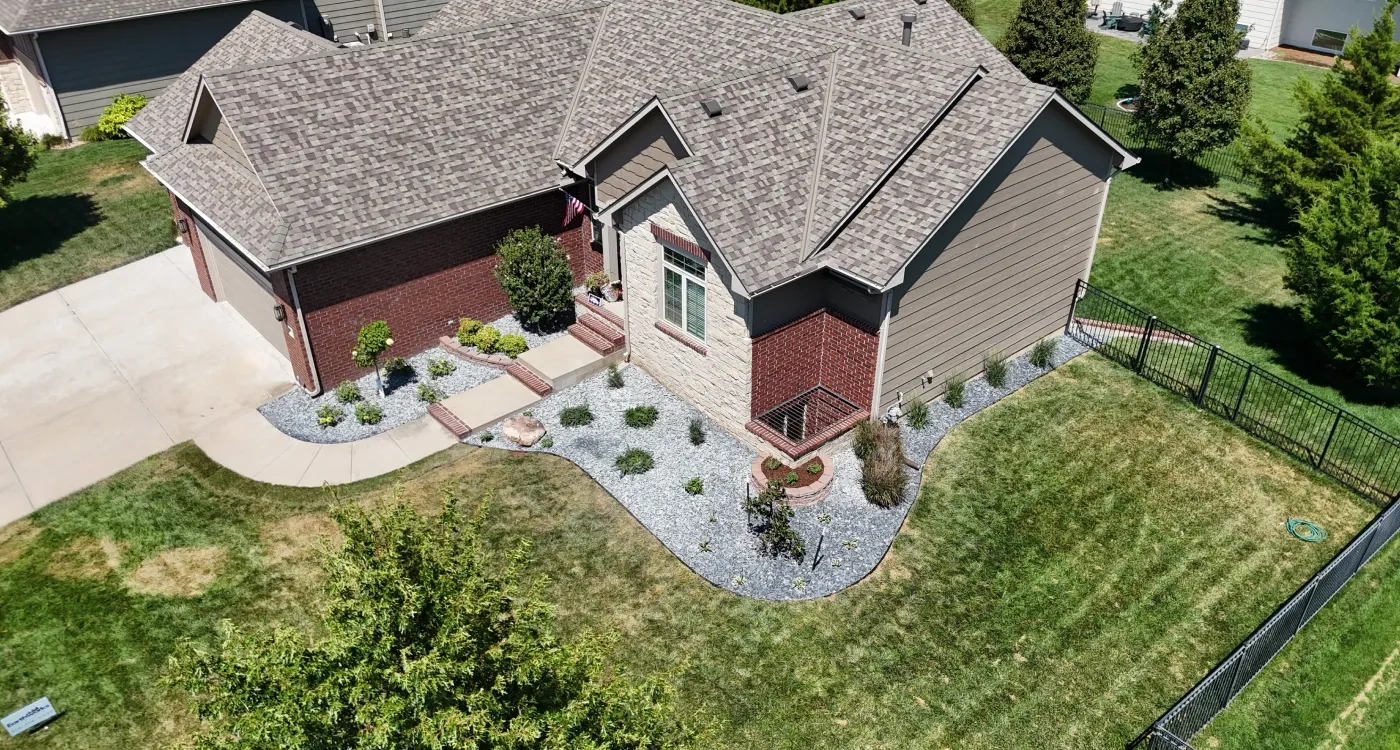
Gravel paths where the lawn was worn anyway
The worn line across the lawn — back door to the gate, patio to the side yard — is usually the strip that browns first. A gravel path there lets rain soak through rather than run off, and never needs a sprinkler. The part you see is the top layer; underneath, a path needs the turf and topsoil dug out, a compacted base of crushed stone so it does not rut in wet clay, and a firm edge so the gravel stays on the path and out of the lawn. For more formal routes and seating areas, our page on custom patios and walkways in Wichita explains why the base decides how long a surface lasts.
Dry creeks that carry storm water and save it
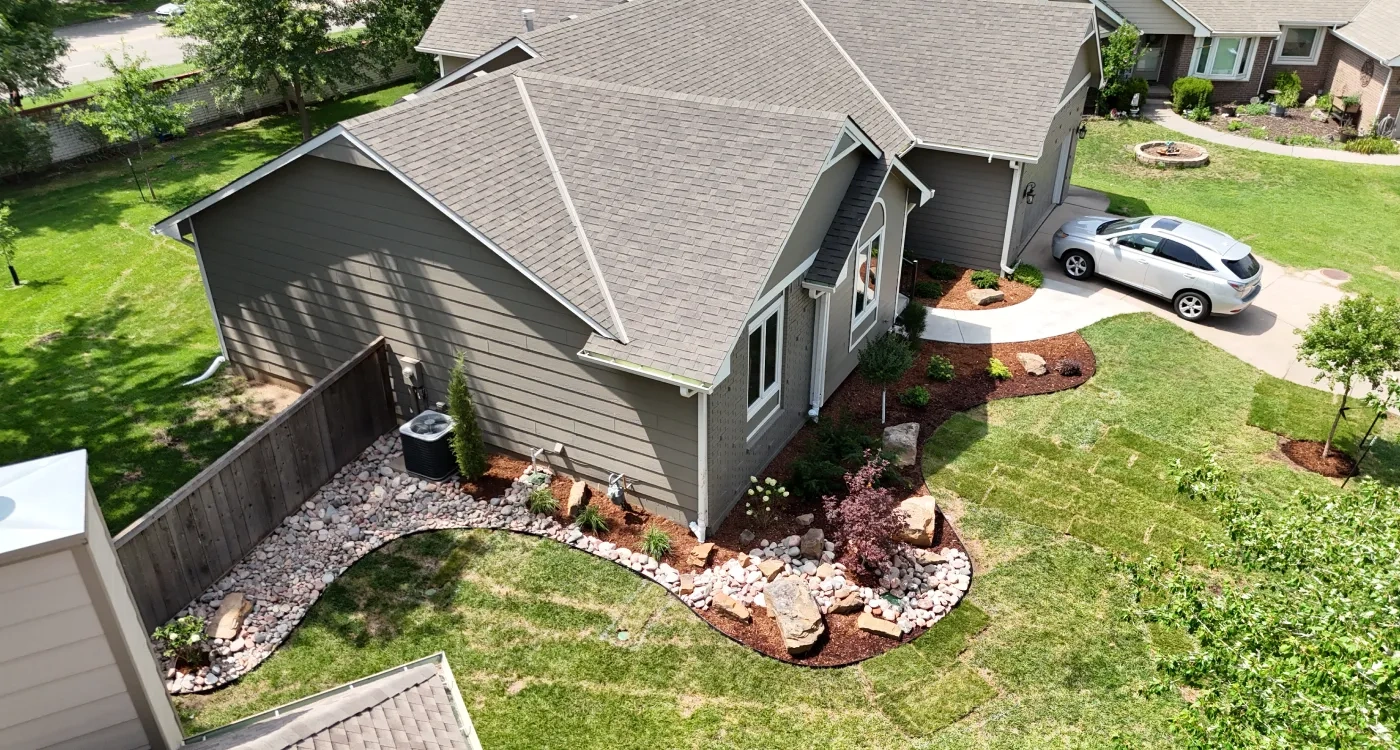
A dry creek bed is the most useful feature in a drought-tolerant Wichita yard, because the trouble here is often less how much rain falls than how it arrives: all at once, in storms that run straight off clay. A creek of rounded cobble and boulders takes the water from a downspout or a low spot, carries it away from the foundation in a storm, and lets some of it soak into the beds beside it on the way. The rest of the year it is a rock feature that asks for nothing.
A dry creek works only if it is built like drainage, not decoration:
It starts where the water does — a downspout, a swale or the low end of a slope.
The bed is dug with a continuous fall, so water never pools in a hollow halfway along.
Fabric goes under the stone so the cobble does not sink into the clay.
Mixed sizes of cobble, with boulders on the banks, keep it from washing out in a heavy storm.
It ends somewhere safe for the water: a planted bed, a soak-away or a swale, never against a neighbor’s fence or back toward the house.
River rock along the side of a house works on the same principle. On the Graber residence, the bed becomes a river rock border set with natural boulders along the side of the house, while the front is finished in mulch. Our comparison of river rock and mulch covers where each holds up in a Wichita summer.
Terraces and walls on a slope
Water runs off a slope before it can soak in, so a sloped yard is a dry yard in July however much it rains in June. Terracing the slope with low retaining walls slows that water and gives each level a flat bed that holds it. Walls need their base and drainage designed with them, especially in clay and freeze-thaw, so they are best planned rather than improvised.
Before any digging: Kansas 811
Gas, electric, water and cable lines do not show on the surface. Contact Kansas 811 a few working days before digging a path, a creek or a planting bed, and check whether your HOA wants to review new hardscape before work starts.
6. Mulch, edge and water in for winter
The last step on the checklist protects everything before it:
Mulch after the ground cools. Two to three inches of shredded wood mulch over the amended beds keeps clay from cracking open in summer and evens out soil temperature in winter. Spread it once the ground has cooled, keep it off stems and trunks, and use gravel instead around the plants that hate wet crowns. Fresh mulch laid early in the season also helps keep weeds down through the summer, so plan to top it up in spring.
Use the leaves. Shredded fall leaves make good mulch or compost for next year’s amending. Whole, matted leaves smother small plants and lawn, so shred or move them.
Set the edges. A firm steel or aluminium edge holds the line between gravel, mulch and lawn, and stops turf creeping into the new beds.
Water in before a freeze. A deep soak before a hard freeze helps new plants through it; dry soil freezes deeper and harder than moist soil.
What to leave until spring
Knowing what not to do in fall saves money as well as plants:
Warm-season grasses, Russian sage, lavender and red yucca: prepare the beds now, plant in spring.
Seeding or sodding new lawn: tall fescue is seeded in early fall, and buffalograss in late spring.
Hard pruning of shrubs and perennials: leave the stems and seed heads standing for winter interest and to protect crowns, then cut back in early spring.
Fertilizing new plantings: it pushes soft growth into the cold and does little for roots.
Poured concrete in a cold snap: it needs warmth to cure, so pours are scheduled around the forecast.
7. Get the drought-tolerant landscape design drawn over winter
The checklist above will make any yard tougher. Where a whole yard is changing at once — lawn becoming beds, water rerouted through a dry creek, paths and a patio tied into the house — the order of work matters as much as the plant list. Grading and drainage go first, because they cannot be retrofitted under finished beds; then walls, paths and patios; then irrigation while the ground is open; and planting last.
That is what our landscape design process sets down on paper. It starts with a free consultation, then a measured site visit that records drainage, grading, existing features and how you use the yard. Our in-house designer draws the plan, with every plant named and counted for the bed it is going into, and within about two weeks of that visit we walk through it with you, along with a detailed proposal. The same team builds from the same drawing. Starting in winter means the plan is ready when the ground is, and you are near the front of the line in spring.
Not for everything. Container-grown trees and shrubs can go in as long as the ground can be dug and you can water them in, and spring bulbs such as daffodils, alliums and crocus belong in the ground in November. Hardy perennials are at the end of their window by late October, and warm-season ornamental grasses, Russian sage, lavender and red yucca are better held until spring, when warm soil lets them root before their first summer.
What are the best drought-tolerant plants for a Wichita yard?
Plants from the prairie and the hot, dry West do best. For structure: bur oak, chinkapin oak, Kentucky coffeetree and Oklahoma redbud among trees, and juniper, fragrant sumac and smokebush among shrubs. For the beds: little bluestem, switchgrass, prairie dropseed and blue grama, with coneflower, black-eyed Susan, yarrow, catmint, salvia, sedum, Russian sage, yucca and red yucca. Every one of them still needs regular water for its first season or two; “drought-tolerant” describes a plant once it is established.
Is rock or mulch better in a drought-tolerant bed?
It depends on the plant. Shredded wood mulch keeps clay cool and moist and feeds it as it breaks down, which suits most shrubs and perennials. Gravel or rock suits the plants that rot when their crowns stay wet — yucca, red yucca, Russian sage, lavender and many sedums — and the strips along a foundation or around an air conditioner where nothing needs to grow. Many good drought-tolerant beds use both.
How do I design my own landscape?
Start with the site, not the plants. Measure the house and lot, mark north, the downspouts, the slope, the wet spots and anything buried, and note where the lawn browns first in August. Decide how each area will be used, draw the patio, paths and beds to scale, then choose plants last, for the sun and soil each bed actually has, grouped by how much water they need. Call Kansas 811 before anything is dug.
What is the 3-5-7 rule in landscaping?
It is a grouping rule: set plants in odd-numbered drifts of three, five or seven rather than in pairs or straight rows, because odd groups read as natural. It suits drought-tolerant planting well — a drift of five little bluestem or seven catmint looks deliberate and shades its own soil, where single plants dotted through rock look sparse and leave more ground to dry out.
What are the six rules of landscape design?
The six principles cited most often are unity, balance, proportion, simplicity, rhythm and emphasis. In a drought-tolerant yard, simplicity does the most work: a short list of tough plants repeated across the property, one or two rock or gravel materials, and a single focal point per view. A yard built from a long list of thirsty one-offs is harder to water and harder to look at.
Is there a free program for landscape design?
Yes. Browser planners such as SketchUp Free and Planner 5D, photo-based apps with free tiers, and free satellite maps with a measuring tool are all good for trying layouts and plant placement. None of them knows how your ground falls, where the water goes in a storm or how slowly your clay drains, which are the things that decide whether a drought-tolerant bed thrives or rots.
How can I get a free landscape design?
You can draw one yourself with free software, and you can get free professional input without a design fee: our consultation is free, and so is the estimate. A full design is a paid deliverable, because a measured plan with grades, drainage and a counted plant list takes real time to draw. Be wary of a “free design” that is really a sketch attached to a bid.
Can ChatGPT do landscape design?
It can help you think — list drought-tolerant plants for a hot west bed, or turn a bed’s measurements into cubic yards of gravel. It cannot see your yard, so it does not know where the downspouts empty, which bed sits wet for a week after a storm or how hard the afternoon sun hits the south wall. Use it for ideas, and check every plant it suggests against what grows well in south-central Kansas.
What is the difference between a landscape designer and an architect?
In Kansas, “landscape architect” is a title the state regulates; it takes a professional degree, experience and a national exam, and landscape architects mostly work on parks, campuses, commercial sites and public projects. A landscape designer focuses on residential gardens and outdoor living — layout, planting, patios and walls. A design-build firm like ours draws the residential plan and builds it with the same team.
The short version
Late October: map the hot beds, the dry strips and where the water runs, and decide where the lawn shrinks.
On a dry day: amend whole beds with compost, never sand, and raise the beds for plants that hate wet roots.
Through November: plant trees, shrubs and spring bulbs, and water them in.
Spring: plant the native grasses, Russian sage, lavender and red yucca into beds prepared now.
Before the ground freezes: build gravel paths and dry creeks, after calling Kansas 811.
Then mulch, edge and water in through dry spells, and get the rest of the yard drawn over winter.
A yard that gets through a Wichita July without a hose in hand is built in the fall before it. When you are ready to plan yours, book a design consultation. With over 30 years of combined experience, we will walk the yard with you, show you where the water and the heat really go, and turn it into a plan our own crews build. We design and build landscapes in Wichita and the surrounding communities of Andover, Derby, Maize and Goddard.
Rock stays put in the wind and never needs topping up; mulch keeps clay cool and feeds it. How the two compare in a Wichita yard — heat, weeds, water at the foundation and years of upkeep — and where each one belongs.
Clay does not absorb water so much as refuse it. Here are the signs that separate a yard with a drainage fault from a yard that was simply rained on, and what fixes each.