Lighting is the only thing you can add to a garden that changes it completely without moving a single thing in it. It is also the addition most often bought as a box of fixtures rather than as a design, which is why so many lit gardens look like a runway.
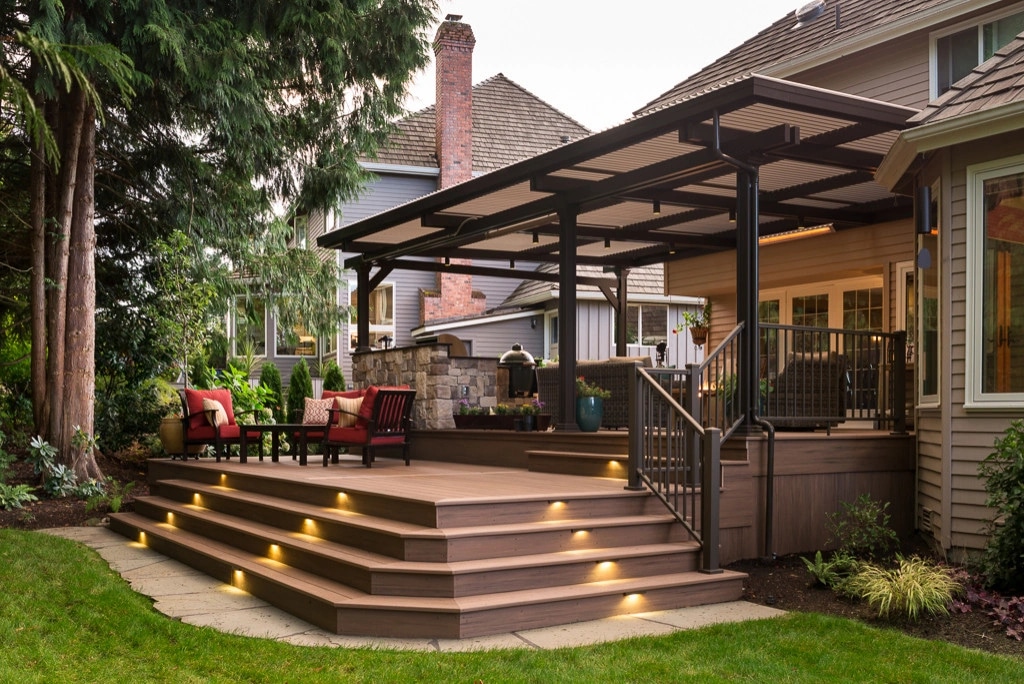
The photograph at the top of this page is worth a second look before you read on. It is doing four separate jobs at once — the trees are uplit, the beds have low path lights running through them, the arbour at the back is lit as a destination, and the lawn itself is left dark. That last decision is as deliberate as the other three.
What lighting is actually for
Three purposes, and it helps to know which one you are buying, because they want different equipment in different places.
Extending the hours. A patio that is unusable after sunset for eight months of the year becomes usable. This is the one that changes behaviour.
Moving safely. Steps, grade changes and the edge of a drop. A change in level that is obvious in daylight is invisible at ten at night.
The view from indoors. Unlit, a window at night is a black mirror. Lit, the garden stays part of the room — and this is where most of the value lands, because it is what you look at every evening.
The four techniques
Uplighting
A fixture at ground level aimed upward into a tree, a wall or a structure. It is the technique with the largest effect for the fewest fixtures, because it uses the object as the light source rather than the fitting. Mature trees with interesting bark or branch structure take it best. Aim matters enormously: a degree or two of adjustment is the difference between lighting a canopy and lighting a neighbour’s bedroom.
Path and area lighting
Low fittings casting a controlled pool downward, along a route. The common failure is spacing them evenly at equal intervals down both sides, which reads as an airport. Better is to light what the path passes — a change in direction, a step, a planting group — and let the gaps between be gaps.
Downlighting
Fittings mounted high in a tree or under a structure, throwing light down. Done well it is the most natural-looking of the four, because it is the direction light normally comes from, and dappled through a canopy it produces something close to moonlight. It requires a mature tree or a pergola or pavilion to mount to, so it is often a second-phase technique. If the structure is still to be chosen, our comparison of a pergola vs a pavilion covers what each one can carry.
Grazing and washing
A fixture set close to a surface and aimed along it grazes — raking across a stone wall to bring out its texture. Set further back and aimed at it, the same fitting washes it in flat, even light. Grazing suits anything with relief, which on most properties means a segmental or natural stone wall. Washing suits smooth surfaces and screens.
Zoning is what makes it feel designed
A single switch that turns on every fixture in the garden gives you one setting, and it is always the brightest one. Zoning splits the system so that different parts run independently — path lighting on its own, the feature lighting on another circuit, the entertaining area on a third.
That is what lets you light a route to the back gate without lighting the whole garden, or run a low ambient setting on a weeknight and everything for a party. Systems can be zoned, dimmed and smart-controlled, with timers and motion sensors where they earn their place. Deciding the zones is a design step, and it is far cheaper to decide before the cable is buried.
Why low voltage
Low-voltage systems reduce maintenance and risk relative to line-voltage installations, and LED fixtures add efficiency and longevity on top of that. They also make zoning, dimming and smart control straightforward rather than an add-on, and they are far more forgiving to extend — adding a fixture in year three does not mean re-engineering the run.
Surviving a Kansas winter
An outdoor lighting system will come through a Wichita winter if it was specified for one. The seasonal swing here requires weatherproof wiring and proper grounding, and the installation is what avoids short circuits, burned-out fixtures and uneven coverage a year or two in.
Two site-specific points are worth raising with whoever quotes the job. Cable routed through beds that will be dug over, or laid shallow across ground that heaves in a freeze, is cable that will be found by a spade. And fittings set at the low point of a bed sit in standing water every time it rains — a drainage problem will shorten the life of a lighting system long before the fixtures themselves fail.
Five things we would change on most existing systems
Too many fixtures, too evenly spaced. Contrast is what makes a lit garden legible. Lighting everything equally removes it.
Nothing lit at the far end. Without a destination, the garden ends where the light does and the space reads as smaller at night than it is.
Glare into sightlines. If you can see the source from the patio or the kitchen window, the fitting is aimed at you rather than at the thing.
One zone. All-or-nothing turns a designed system into a floodlight.
Retrofitted after the hardscape. No sleeves under the paving means either a visible surface run or cutting into a finished patio.
The fifth is the reason lighting belongs in the drawing rather than in a later phase — see how the design process handles it. If you have an existing garden and want to know what is possible in it, our guide to planning landscape lighting in Wichita covers which areas to light, which fixtures do which job and how the wiring and controls get specified.
Most design advice is written for a climate that is not this one. This is how a plan gets made for a Kansas property, and why the drawing is worth paying for before anybody quotes the build.
The word covers everything in a garden that is not alive. Knowing which parts of your yard are hardscape, and what each one is for, changes how you brief anybody you hire.